
The fastest reliable path is a combination, not a single step: ask two or three people you trust for a referral, then confirm each candidate's license and pull their last 3 to 5 local buyer closings before you talk money. Interview two to four agents with the same questions. Start today by asking one person for a name, or browse curated agent profiles on RealtiFy to see credentials up front.
TL;DR:
- Verify recent local closings within the last year to ensure an agent's current market activity, rather than relying solely on their total years of experience.
- Prioritize agents with REALTOR® membership or ABR certification, and cross-check their references and online reviews from multiple sources for reliability.
- Ask specific questions about recent neighborhood deals, handling bidding wars, and negotiation outcomes to assess an agent's practical recent experience.
- Review written buyer agreement terms carefully, focusing on compensation details, service scope, duration, and clear termination rights before signing.
- Use curated platforms like RealtiFy to see verified agent credentials, receive direct messaging access, and reduce the time spent on manual credential and reference checks.
Table of Contents
- Where to Find a Buyer's Agent Near You
- How Do You Check an Agent's Credentials and Track Record?
- Interview Questions That Reveal Whether an Agent Is Right for You
- What's in a Written Buyer Agreement, and How Do Fees Work?
- Red Flags to Watch For and a Final Decision Checklist
- How RealtiFy Vets Agents and Matches Buyers Faster
- What Most Buyer's Agent Advice Gets Backwards
- Start Your Search on RealtiFy
- Sources
- FAQ
Where to Find a Buyer's Agent Near You
Referrals from people who just closed on a home beat cold searches almost every time, because a friend or coworker will tell you the truth about how an agent handled a bidding war or a slow inspection response. Ask your loan officer too, but treat lender-suggested names as one data point, not a shortcut past your own vetting.
Beyond referrals, here's where real candidates surface:
- Agent directories on brokerage sites and REALTOR® association pages, where you can filter by neighborhood and check listed specialties and recent sales.
- Open houses, where the agent standing in the kitchen is often actively working buyers in that exact market and can speak to pricing trends on the spot.
- "Sold" signs and recent closings in the neighborhood you're targeting, which point you toward agents who already know that specific street-by-street market.
- Local online groups (neighborhood forums, city subreddits, Facebook community pages), where past buyers often name names, good and bad.
Be cautious with agents from paid lead networks or referral services. These arrangements sometimes involve fees that shape which agent gets assigned to you, not necessarily the best fit for your search.
How Do You Check an Agent's Credentials and Track Record?
A license lookup takes five minutes and tells you whether an agent is in good standing or carrying disciplinary history. Every state runs its own real estate commission database, and cross-referencing it against a broader tool like NMLS Consumer Access adds another layer of verification, particularly for agents who also touch mortgage-adjacent services.
From there, look for these specific signals:
- REALTOR® membership, which binds the agent to a code of ethics enforceable by their local association.
- The ABR (Accredited Buyer's Representative) designation, a credential that requires specific buyer-side training most listing-focused agents skip.
- Recent local closings, weighted more heavily than lifetime sales volume. An agent with 200 sales over 15 years but zero closings in your target zip code in the last year knows less about today's market than someone with 8 recent local deals.
- References and reviews, cross-checked across Google, Zillow, and the agent's own site rather than taken from a single glowing testimonial page.
Pro Tip: Ask an agent for their three most recent buyer closings, not their best ones. Recent activity in your specific area tells you far more than a highlight reel from three years ago.
Interview Questions That Reveal Whether an Agent Is Right for You
Run the same script with every candidate so you're comparing apples to apples. NAR's own consumer guidance points to a similar structure: ask direct, specific questions before you commit.
- How many buyer closings have you had in this neighborhood in the last 12 months?
- How do you find listings before they hit the major sites, and how do you handle a bidding war?
- How does your compensation work if the seller offers less than you'd normally charge?
- What's the length of your buyer agreement, and how do I terminate it if things aren't working?
- Can you walk me through a recent negotiation where you saved a client money or beat out a competing offer?
- Can I contact two of your most recent buyer clients directly?
Listen for specifics. An agent who answers with numbers, addresses, and outcomes is worth a second conversation. One who answers in generalities probably hasn't closed much lately.
What's in a Written Buyer Agreement, and How Do Fees Work?
Since the NAR settlement changes took effect in August 2024, buyers should expect to sign a written agreement before touring homes, not after finding "the one." That agreement is where compensation, services, and your exit rights all get spelled out, so read it slowly before you sign anything.
Check these items line by line:
- Exact compensation language. How much, paid by whom, and what happens if the seller's offer covers less than the agreed amount.
- Services promised. Does the agreement cover showings only, or full negotiation and closing support?
- Duration. A short duration is common for a first agreement with a new agent; six months or longer suits someone you've already vetted.
- Termination rights. Confirm exactly how and when you can walk away if the relationship isn't working.
Some claim there is a standardized "3-3-3 rule" for buyer agreements. No such national standard exists. Always check the actual agreement language and your state's rules instead of trusting a shortcut you saw on social media.
On compensation transparency, the Consumer Financial Protection Bureau (CFPB) has flagged referral fees and marketing arrangements as areas that can create conflicts under RESPA. If an agent came to you through a referral network, ask directly whether money changed hands for that introduction. The CFPB's enforcement action against Rocket Homes over referral fee arrangements is a real example of why that question matters, not a hypothetical.
Red Flags to Watch For and a Final Decision Checklist
Some warning signs show up in the first conversation. Others only surface once you start comparing candidates side by side.
Watch for these:
- Vague answers about recent local closings or an unwillingness to name specific deals.
- Pressure to sign a long buyer agreement (six months or more) before you've had a single showing together.
- Reluctance to explain how their compensation works if the seller's offer falls short.
- No references, or references that all sound suspiciously identical.
Before you sign, weigh responsiveness, a clear recent sales history in your target area, at least one specific negotiation example, and paperwork you actually understand.
Pro Tip: If you're on the fence after three interviews, keep looking. A rushed hire on your buyer's agent is harder to undo than a rushed offer on a house.
How RealtiFy Vets Agents and Matches Buyers Faster
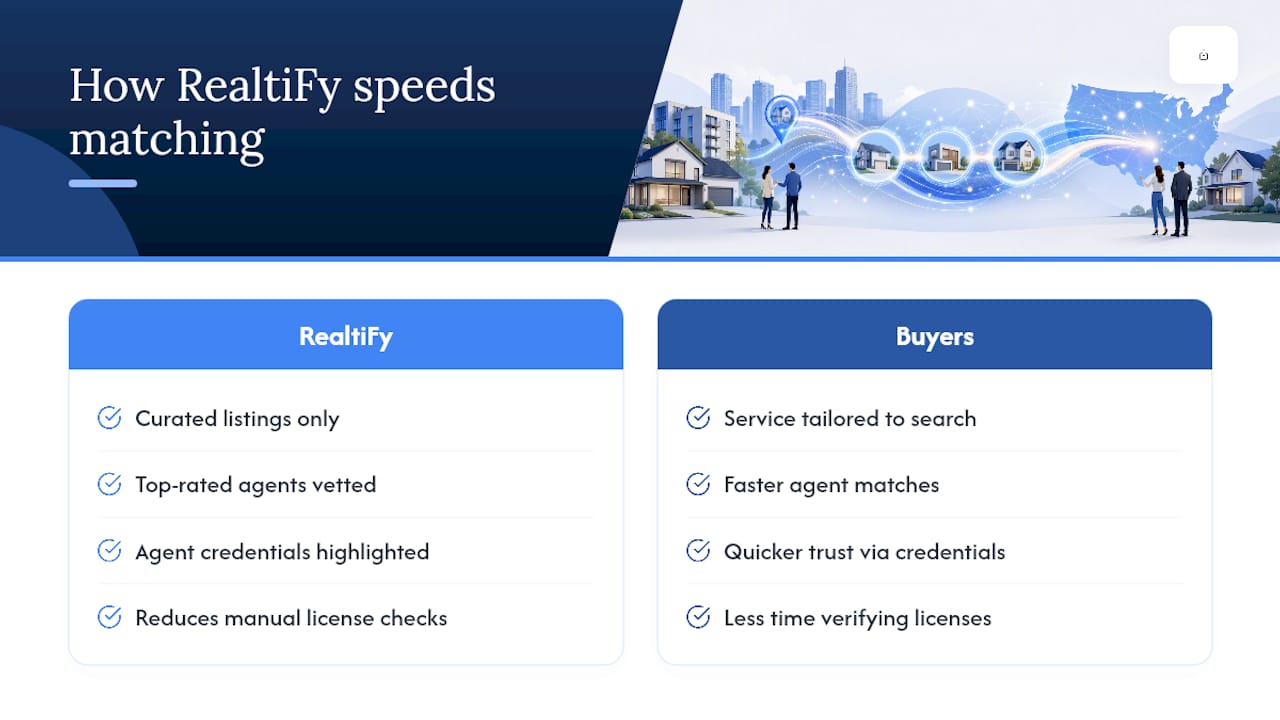
RealtiFy is a real estate platform built around matching buyers with their ideal homes through curated listings and top-rated agents, rather than an open directory where anyone can list. The platform highlights agent credentials so clients get service tailored to their specific search, which cuts down the manual license-checking and reference-hunting described above.
RealtiFy also gives buyers direct messaging with agents, with no middlemen or transaction fees standing between the two of you. First-time buyers, investors comparing multiple markets, and people relocating to an unfamiliar city tend to benefit most, since they usually have the least existing network to pull referrals from.
What Most Buyer's Agent Advice Gets Backwards
Most guides treat finding an agent like a paperwork exercise: check the license, read the contract, sign here. That's necessary, but it misses the actual failure point. Buyers rarely get burned by an unlicensed agent. They get burned by hiring someone competent on paper who has zero recent activity in their specific neighborhood.
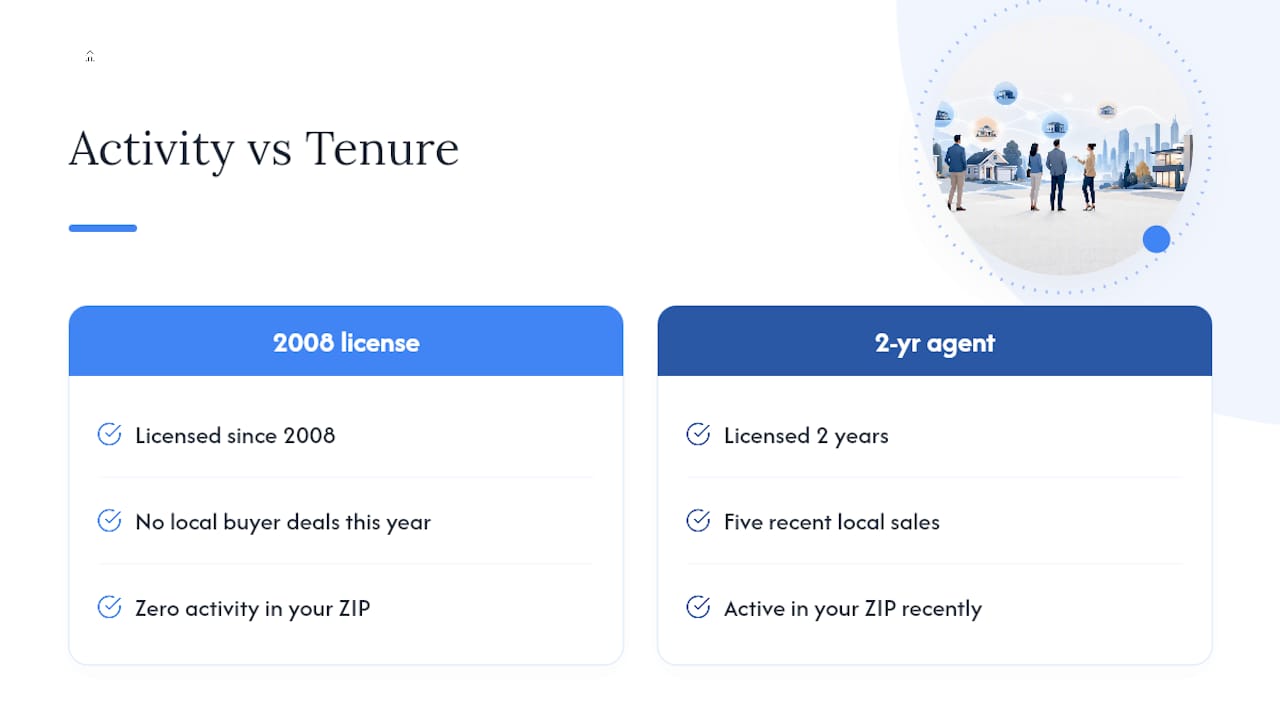
Recent local closings matter more than years in the business, full stop. An agent who's been licensed since 2008 but hasn't closed a buyer deal in your zip code this year knows less about current pricing than someone two years into the job with five recent local sales. Weight your interview questions accordingly.
The other place conventional advice underperforms is transparency around compensation. The NAR settlement changes put the written agreement front and center, which is good, but a signed agreement doesn't protect you if you never asked how the agent got assigned to you in the first place. Referral fees and lead-network arrangements are legal in many cases. They're just not always disclosed unless you ask.
If you're short on personal referrals, a curated platform that vets credentials before you ever pick up the phone solves a real gap, not a manufactured one.
— Jadin
Start Your Search on RealtiFy
Some platforms help reduce the need to spend a weekend cross-referencing license databases and cold-emailing strangers for references. Often, agent profiles show verified credentials, so the vetting work covered in this guide may be largely done before you make contact.

Getting started takes three steps. Browse curated property listings in the areas you're considering, then check the credentials on any agent profile that catches your eye. From there, send a direct message through the platform, no middleman, no transaction fee, and no waiting on a lead-network callback.
Once you request a match, expect a response directly from the agent rather than a call center. If you're an agent looking to be part of that curated pool, you can also set up your own profile on RealtiFy. For buyers ready to move now, start by browsing listings and reaching out to the agent whose track record fits your neighborhood.
Sources
- CFPB: RESPA regulation and referral guidance
- CFPB enforcement: Rocket Homes RESPA complaint
- Consumer guide: ten questions to ask a buyer's agent — NAR
FAQ
Is It Worth Paying for a Buyer's Agent?
Most buyers think so: Most home purchases involve an agent, largely because negotiating, scheduling inspections, and navigating closing paperwork alone is harder than it looks. A good buyer's agent often pays for themselves through negotiated price reductions or repair credits they catch that a first-time buyer would miss.
What Is the 3-3-3 Rule in Real Estate?
There's no official national "3-3-3 rule" for buyer agreements or agent hiring. NAR's own guidance makes clear that agreement terms vary by brokerage and state, so always read the actual contract instead of relying on a rule of thumb you saw online.
What Is the Hardest Month to Sell a House?
This varies by local market and season, and the article's research doesn't point to a single verified national figure for hardest-selling months. Ask a local agent with recent closings in your target area. They'll know the seasonal patterns for that specific neighborhood better than any national average.
How Much Would a Real Estate Agent Make on a $300,000 House?
Compensation depends entirely on the terms in the written buyer agreement and whether the seller is covering some or all of it, so there's no fixed percentage to quote. Since the NAR settlement changes, that number is negotiated upfront and must be spelled out in your signed agreement before you tour a single home.