

Mortgage preapproval is a lender's conditional written commitment stating how much it will likely lend you, based on a review of your income, credit, and assets. It gives you a realistic price range before you start touring houses and signals to sellers that your offer is credible. It is not a guaranteed loan, and most letters expire within 30 to 60 days.
TL;DR:
- Preapproval letters are valid for 30 to 60 days and involve a hard credit pull, but multiple inquiries within 45 days only count as one for scoring.
- Lenders base preapproval amounts on income, debt-to-income ratio, credit score, and assets, requiring specific documentation like pay stubs, tax returns, and bank statements.
- Fully underwritten preapprovals, verified by human review, carry more weight with sellers than automated ones, especially in competitive markets.
- Different loan programs have unique preapproval requirements, with VA loans often needing no down payment and fewer restrictions, while conventional loans require higher credit scores.
- Comparing full costs includes APR, lender fees, and estimated cash to close, since the interest rate alone does not reflect true borrowing costs.
Table of Contents
- What's the Difference Between Preapproval and Prequalification?
- Why Getting Preapproved Puts You Ahead in a Bidding War
- What Lenders Check: Income, Debt, Credit, and Assets
- Document Checklist: Everything to Gather Before You Apply
- How to Apply for Mortgage Preapproval, Step by Step
- How Long Does Preapproval Last, and Does It Hurt Your Credit?
- How to Compare Preapprovals and Pick the Right Lender
- How Realtify Turns Your Preapproval Into a Real Offer
- FHA, VA, and Conventional Loans: How Preapproval Requirements Differ
- When a Verified Preapproval Is Worth the Extra Effort
- Ready to Search? Here's How Realtify Fits In
- Where to Verify Preapproval Rules and Requirements
- Sources
- FAQ
What's the Difference Between Preapproval and Prequalification?
Prequalification is a quick estimate. You share basic numbers verbally or through a short online form, the lender usually runs a soft credit check that doesn't affect your score, and you get a ballpark figure in minutes. It's useful for a first gut check on affordability—nothing more.
Mortgage preapproval goes deeper. A loan officer verifies your income, debts, and credit through documentation, and the process typically involves a hard credit pull. You come away with a preapproval letter carrying real weight with sellers.
Use prequalification when you're just starting to think about buying. Get preapproved once you're seriously house hunting, because agents and sellers in most markets expect that letter before they'll take your offer seriously.
Why Getting Preapproved Puts You Ahead in a Bidding War
Sellers and their agents read a preapproval letter as proof you can close, not just that you want to buy. In competitive markets, an offer without one often gets skipped over entirely, regardless of price.
Preapproval also does the budgeting work for you. Instead of guessing what you can afford, you get an actual ceiling from a lender who has looked at your real numbers, which keeps you from falling for a house that stretches your finances thin. The CFPB notes that catching financial issues early, before you're competing for a specific property, gives you time to fix them.
Timing matters too. In fast-moving markets, get preapproved before you start touring homes seriously, not after you've found "the one" and have 48 hours to write an offer.
What Lenders Check: Income, Debt, Credit, and Assets
Lenders build your preapproval amount around four pillars: income, debt-to-income ratio, credit history, and assets. Each one moves the number up or down.
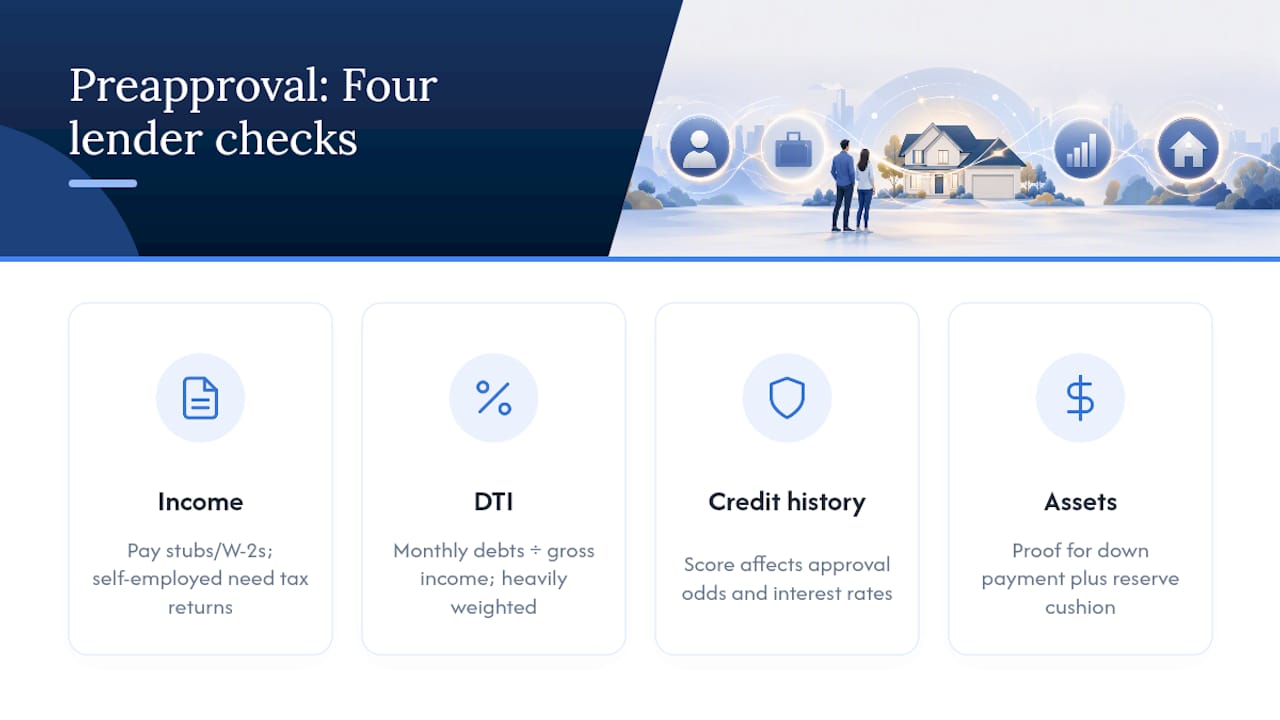
Income verification typically means recent pay stubs and W-2s for salaried workers. Self-employed applicants usually need two years of tax returns, profit-and-loss statements, and sometimes 1099 forms, since lenders want a consistent earnings pattern rather than one strong quarter.
Debt-to-income ratio (DTI) compares your monthly debt payments to your gross monthly income. Fortune's guide to preapproval points out that DTI and credit score carry outsized weight in both loan sizing and the rate you're offered.
Credit history affects both approval odds and pricing. A higher score generally unlocks lower rates, while a thin or bruised credit file can shrink your borrowing power even if your income looks solid.
Assets and reserves matter because lenders want proof you can cover the down payment plus a cushion afterward, not just scrape together closing costs.
Document Checklist: Everything to Gather Before You Apply
Having your paperwork organized before you apply is the single biggest thing you can do to avoid delays. Lenders commonly ask for a version of this list:
- Government-issued photo ID and your Social Security number for identity verification
- Recent pay stubs (usually 30 days) and W-2s from the last two years
- Two years of federal tax returns, especially if you're self-employed or have variable income
- Bank and investment account statements from the last two to three months showing down payment funds and reserves
- Proof of any additional income, like rental income or a signed gift-fund letter if family is contributing to your down payment
The Lower mortgage guide lists this same core set of documents as standard across most lenders. Keep digital copies in one folder labeled by category. Most delays happen because a bank statement is missing a page or a large deposit shows up unexplained, so flag anything unusual before you submit.
How to Apply for Mortgage Preapproval, Step by Step
The process is straightforward once your documents are in order. Here's the sequence that gets you a letter fastest.
- Pick two or three lenders to compare — a bank, a credit union, and an online lender each price things differently, so casting a wide net pays off.
- Submit your application and consent to a credit check. This is where the hard inquiry happens, so try to do this step with all your chosen lenders close together in time.
- Upload your documents right away. Pay stubs, tax returns, and bank statements should go in with the application, not trickle in over a week.
- Respond fast to any follow-up requests. A loan officer asking for one more bank statement can stall your file for days if you sit on the email.
- Receive your preapproval letter, then hold your finances steady. Avoid new credit cards, car loans, or large unexplained deposits until after closing.
Pro Tip: Once you have your letter, request Loan Estimates from each lender on the same day so you're comparing apples to apples on rate, fees, and cash-to-close before you commit to one.
How Long Does Preapproval Last, and Does It Hurt Your Credit?
Most preapproval letters stay valid for 30 to 60 days, though some lenders stretch that to 90. Once it expires, you'll need updated documents and often a fresh credit pull to renew it.
On the credit question: yes, a true preapproval usually involves a hard inquiry, but you don't need to worry about applying with multiple lenders. Credit-scoring models generally treat multiple mortgage inquiries made within about 45 days as a single inquiry, so shopping around in a tight window barely dents your score.
One thing preapproval does not do: lock your interest rate. That happens later, when you formally lock in with your chosen lender after going under contract.
How to Compare Preapprovals and Pick the Right Lender
The loan amount on the letter is only part of the picture. A smart comparison looks at the full cost and reliability of each offer.
- Line up the APR, lender fees, and estimated cash-to-close from each Loan Estimate side by side, since a Freedom Mortgage guide notes these figures reveal the real cost differences between lenders that a headline rate can hide.
- Ask directly whether your preapproval was automated or fully underwritten — an underwritten letter, backed by verified documentation, tends to carry more weight with sellers in competitive bidding situations.
- Weigh service and speed to close, particularly if you're using a loan program (FHA, VA) where not every lender has equal experience closing on time.
How Realtify Turns Your Preapproval Into a Real Offer
A preapproval letter only helps once it connects you to the right property and the right agent fast. The platform's agent profiles present credentials up front, allowing you to identify specialists for your loan type and price range before making contact.
Direct messaging removes the need to go through a call center, enabling users to coordinate document requests and offer timing more efficiently. Combined with curated listings tailored to your preapproved price range, this approach helps you act quickly on new properties.
FHA, VA, and Conventional Loans: How Preapproval Requirements Differ
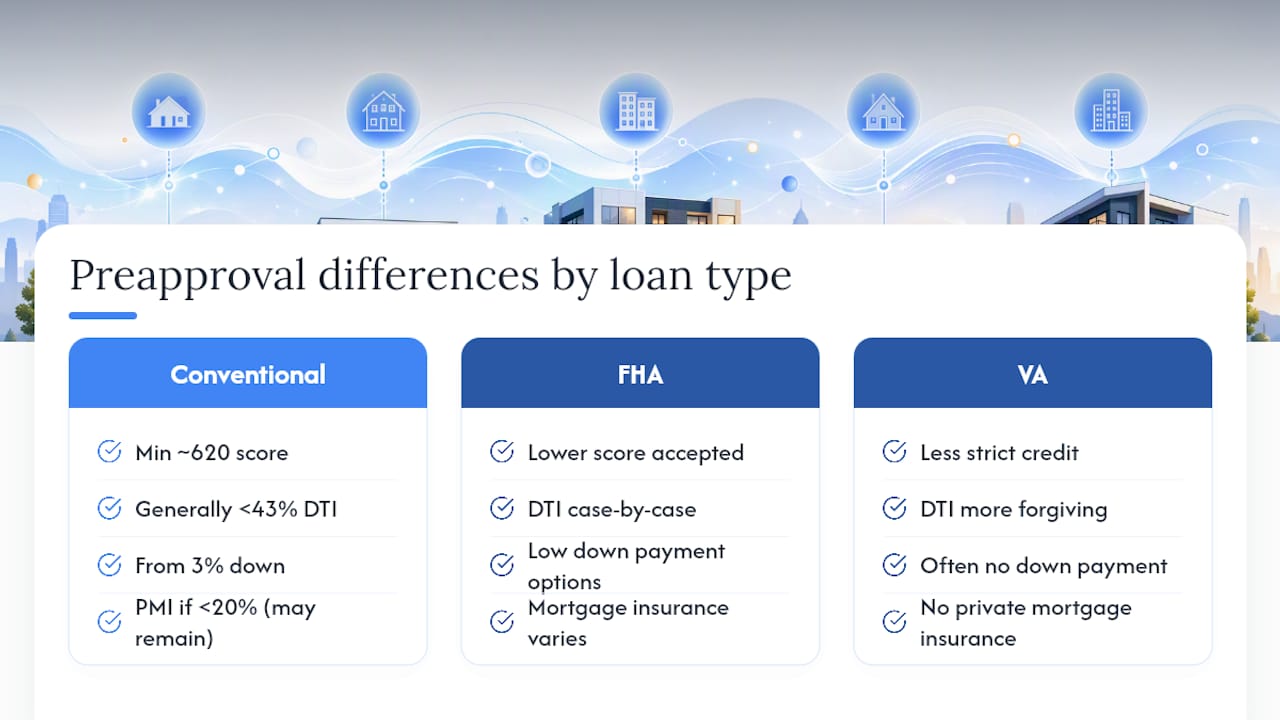
Not every loan type asks for the same things during preapproval, and knowing the differences upfront saves you from applying for the wrong program.
Conventional loans typically require the strongest credit profile of the three, often a minimum score in the 620 range, along with a DTI generally under 43% or higher with strong compensating factors. Down payments can go as low as 3% for qualified first-time buyers, but private mortgage insurance kicks in below 20% down.
The tradeoff is mortgage insurance premiums that stick around for the life of the loan in many cases, and the property itself must meet HUD's minimum standards during appraisal. HUD's fair housing guidance also applies broadly here, since agents and lenders working with FHA buyers are bound by the same nondiscrimination rules as any other transaction.
VA loans, available to eligible veterans and service members, often require no down payment at all and skip private mortgage insurance entirely. Preapproval documentation includes a Certificate of Eligibility on top of the standard income and asset paperwork, and DTI limits tend to be more forgiving than conventional guidelines.
Each program also varies on documentation depth. FHA and VA lenders sometimes ask for additional verification around employment gaps or military service history that a conventional lender wouldn't require. If you're not sure which program fits, ask a loan officer to run your numbers against two or three programs before you commit to one preapproval path.
When a Verified Preapproval Is Worth the Extra Effort
Not all preapproval letters carry the same weight, and pretending otherwise does buyers a disservice. An automated preapproval, generated from self-reported numbers and a credit pull, is fine for a slow market or a first-time browse of your budget.
In a competitive market where multiple offers land on a property in days, a fully underwritten letter, one where a human has actually verified your pay stubs and bank statements, tells the seller's agent you're not going to fall apart in underwriting. Ask your lender directly which type you're getting.
Watch for red flags: a letter with no loan amount specified, no lender contact information, or one issued without any credit check at all. Sellers' agents have seen enough weak letters to spot these instantly.
— Jadin
Ready to Search? Here's How Realtify Fits In
Realtify is the alternative to sorting through anonymous listing sites once your preapproval letter is in hand. Instead of guessing which agent actually knows your target neighborhood or loan program, you see verified credentials before you reach out, and you message agents directly with no middleman slowing things down.

That direct line matters most in the days after preapproval, when a property in your range can get multiple offers within 48 hours. Listings are curated to help you avoid outdated or irrelevant results and find homes appropriate to your approved price range. Browse current property listings that match your budget, or check how the platform works at Realtify's overview page before you start reaching out to agents.
Where to Verify Preapproval Rules and Requirements
For anything involving your specific financial situation, go straight to primary sources rather than relying on secondhand summaries.
- Consumer Financial Protection Bureau: official guidance on preapproval letters, validity periods, and lender obligations
- HUD Fair Housing: nondiscrimination rules that apply throughout the homebuying process
- USA Today's mortgage preapproval guide: practical steps and credit inquiry timing
- Fortune's preapproval explainer: breakdown of income, DTI, and credit factors lenders weigh
This article is general information, not a substitute for advice from a qualified financial advisor. Consult a qualified financial professional about your own circumstances before acting on anything here.
Sources
- Get a preapproval letter | Consumer Financial Protection Bureau
- Mortgage Preapproval | Navy Federal Credit Union
- How mortgage preapproval works: Steps, requirements and tips | USA Today
FAQ
How Do I Get Preapproved for a $200,000 Mortgage?
You'll need stable income, a manageable debt load, and typically a qualifying credit score depending on the loan program. Gather your pay stubs, two years of tax returns, and bank statements, then apply with two or three lenders so you can compare offers before committing.
How Much Income Do I Need for a $400,000 Mortgage?
It depends heavily on your existing debt and the interest rate, since lenders generally want your total monthly debts, including the new mortgage, to stay under roughly 43% of your gross monthly income. Your lender's preapproval review of your full financial picture is the only way to know your actual borrowing limit.
What Income Qualifies for a $250,000 Mortgage?
Buyers typically need sufficient household income to comfortably support a loan this size, assuming limited other debt and a standard down payment. Your specific DTI, credit score, and down payment amount will shift that borrowing power up or down.
How Much Do You Need to Make for a $500,000 Mortgage?
Most buyers need sufficient household income to qualify for a loan this size, though a larger down payment or lower existing debt can lower that threshold. A lender calculates your exact number using your DTI and credit profile, not a flat income rule.
What Happens if My Mortgage Preapproval Gets Denied?
Ask the lender exactly why, since it's often a fixable issue like a high DTI, a recent late payment, or missing documentation. Paying down a credit card, correcting a credit report error, or waiting a few months to rebuild your profile often resolves it, and a different lender's program may fit your situation better anyway.